
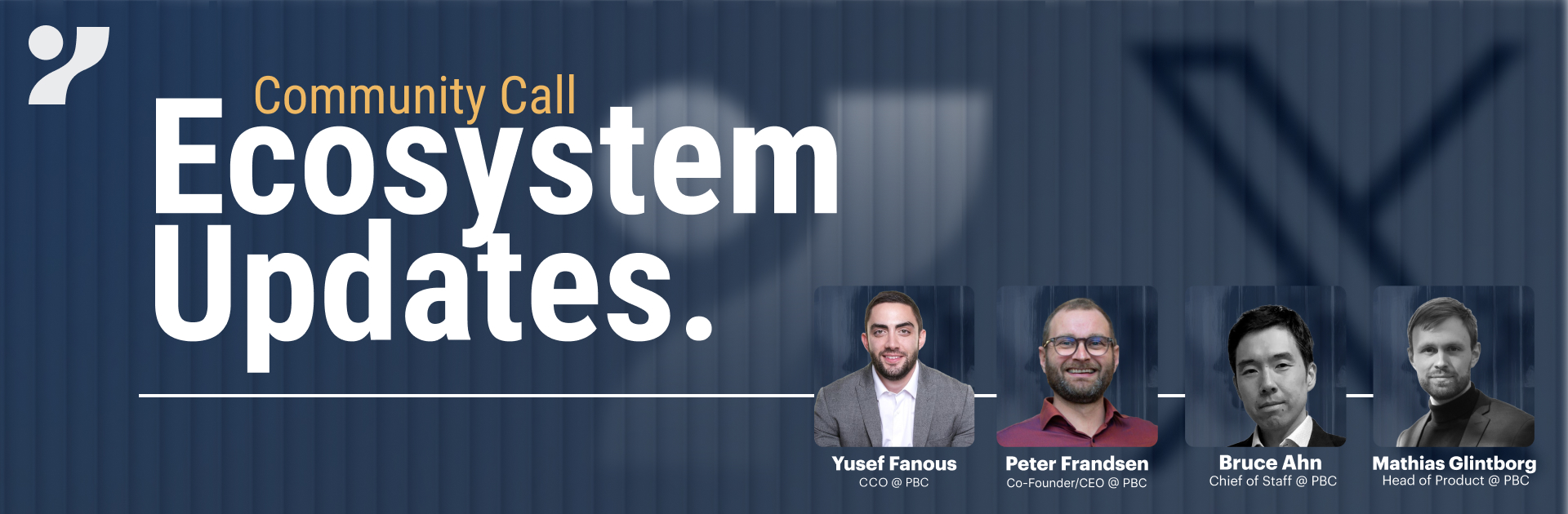
Listen to Partisia Blockchain Community Call – 19th Nov, 2025
Led by Yusef Fanous (Chief Commercial Officer), the session brought direct technical updates from Bruce Ahn (Chief of Staff), Mathias Glintborg (Head of Product), and Peter Frandsen (Co-Founder & CEO), the latest Community Call provided a clear view of how the network, products, and ecosystem are maturing.
The session opened with a reminder of the foundation’s long-standing commitment to bringing digital trust to the world, delivered through enterprise-grade, confidential-compute infrastructure built on decades of research into multiparty computation.
This is not a new direction but the continuation of a journey that began in the 1980s and has since evolved into production-ready blockchain infrastructure. What was once a specialist academic field is now becoming a requirement: across Web3 and regulated sectors, privacy-by-design is no longer fringe but increasingly recognised as essential for mainstream adoption.
As Yusef noted, major layer-one networks and global regulatory frameworks are converging on the same need for compliant privacy technology, a trend that is fast becoming the new normal, and reinforces the foundation’s trajectory and validates its early commitment to privacy-enhancing cryptography.
The remainder of the call highlighted how this direction is taking shape today: faster block production, growing BYOC activity, projects launching on mainnet, and new tooling designed to support real adoption across the ecosystem. The sections below summarise the key developments across the network, product roadmap, and partner ecosystem.
Network Health, Performance & Node Economics
Record Network Performance
Bruce kicked off the technical update with a strong headline: the network is operating at a “record status” of performance, with block production consistently in the 200–300 millisecond range. This level of throughput supports responsive dApps, predictable execution, and a stable user experience as adoption grows.
For context: major layer-one networks typically operate with block times measured in seconds or even minutes rather than milliseconds. For a direct comparison you can explore public metrics such as the Ethereum Average Block Time chart and the Bitcoin Block Time chart.
That difference matters for builders: lower block times mean faster confirmations, more predictable execution, and a better foundation for applications that expect interactive, near-real-time behaviour.
Sub-second block times are a foundational requirement for enterprise and Web3 applications expecting real-time interaction or low-latency services. Faster confirmations and more consistent throughput ensure developers can rely on the network as usage increases.
Mainnet stability remains strong, validator participation is healthy, and ongoing stress testing continues to validate performance under realistic load.
BYOC Rewards and On-Chain Value
The call also reaffirmed that network activity is generating tangible economic value for node operators. Stress testing has already produced over $10,000 in BYOC rewards, while CryptoFactor’s interchain activity continues to contribute additional value as assets move across chains.
The trajectory is encouraging: utility-driven rewards are starting to become a meaningful part of operator economics.
Streamlined Validator Onboarding (KYB)
To support a broader and more diverse validator set, a new KYB-based onboarding flow has been approved. The updated process reduces friction for new operators while maintaining essential compliance requirements, helping strengthen the network’s long-term decentralisation and resilience.
Product & Protocol Development: Roadmap Aligned With Adoption
Execution Engine and MPC-Powered Applications
Mathias Glintborg highlighted how the current development cycle is anchored in a clear principle:
“The focus this year, and the next half year, has been around adoption and the need for adoption.”
A central pillar of that direction is the Execution Engine, a flexible layer that lets projects and businesses run the parts of their application logic that require privacy, while still benefiting from Partisia Blockchain’s built-in security, transparency, and upgrade paths.
The Execution Engine is already being used in production. Teams like idOS and CrowdSnap have built it into their systems, showing how projects can run sensitive operations privately while still keeping everything transparent and verifiable on-chain.
Tooling, Browser Enhancements & Infrastructure Improvements
Driven heavily by feedback from builders and node operators, recent upgrades include:
- Automated API fee calculation
- More intuitive staking and delegation interfaces
- Weekly snapshots for faster reader-node setup
- Stability refinements across RPC and API services
- Browser improvements for deposits, staking, and delegation clarity
These updates reduce operational friction and create a more reliable foundation for the ecosystem as activity increases.
Projects Shipping on Mainnet
More partners are now moving from development into live deployment, each demonstrating how confidential compute and privacy-enhancing technology can support practical applications across staking, interoperability, and digital identity.
Sceptre – Liquid Staking for MPC
Sceptre launched its liquid staking platform for MPC through a community-first release. The goal is to gather feedback and refine the experience before broadening promotion. With much of the MPC supply already staked, early liquidity movement is expected to progress steadily.
The team is preparing a liquidity pool pairing $sMPC and $MPC, which is expected to unlock broader participation once deployed. Liquid staking introduces more flexibility for MPC holders and strengthens the network’s economic layer.
CryptoFactor – Interchain Activity and BYOC Utility
CryptoFactor’s interchain system is fully operational on Partisia Blockchain as a private application chain using ZK node functions and decentralised storage. It supports asset bridging between networks such as DeFiChain and Polygon, with PBC nodes performing the work and earning BYOC rewards.
The system has already generated several thousand dollars’ worth of BYOC during its beta and early live phases, and usage is expected to expand as more clients integrate. This represents interoperability in practice: real users, real value, and real rewards for the infrastructure that powers it.
CrowdSnap – Privacy-Preserved Proof of Humanity
CrowdSnap presented its first iteration of MPC-protected Proof of Humanity, combining biometric input with MPC to create a reusable digital identity that can later be verified through a quick face scan, without exposing raw biometric data.
“We collect the biometrics and privatize them using MPC… The digital identity can later be verified with a quick face scan.”
The product is production-ready, with beta users active and interest from industries exploring privacy-preserving identity solutions. It represents one of the clearest applications of confidential compute within the ecosystem.
Vision and Governance: Privacy, Compliance & Digital Trust
The call also reinforced how the foundation’s direction aligns with emerging needs across Web3 and regulated industries. Privacy-by-design, compliant data handling, and confidential compute remain at the centre of the network’s development, a stance reflected not just in the technology, but in how the ecosystem is being guided.
Yusef highlighted how multiparty computation and zero-knowledge proofs are embedded natively at protocol level, rather than added as optional layers. This architectural choice is becoming increasingly important as global frameworks, from GDPR and PSD3 to eIDAS 2.0 and Japan’s Trusted Web, continue moving toward stricter requirements around privacy, identity, and data sovereignty.
On the research and development front, Peter Frandsen noted ongoing work around MPC-as-a-second-layer functionality and associated patents, reinforcing the foundation’s long-term commitment to privacy-preserving computation and interoperability as core pillars of the network.
Q&A: Community Themes, Responses, and Next Steps
The Q&A portion of the call highlighted themes around communication cadence, governance clarity, and collaboration across the ecosystem. Below is a consolidated summary of the key topics raised by the community, along with how the foundation responded.
Call Frequency and Community Touchpoints
Community insight:
Participants expressed interest in having ecosystem calls more frequently, potentially every two weeks, and suggested leaning more on Discord to keep discussions active between calls.
Foundation response:
The team welcomed the suggestion for more frequent calls and agreed it would help keep everyone more connected. They confirmed that future sessions will reflect this feedback, with an ongoing focus on staying open and accessible to the community.
Public Audit and Governance Transparency
Community insight:
A question was raised about whether the foundation would consider publishing a public audit for the network.
Foundation response:
Peter clarified that governance-sensitive topics require proper context and should remain within the dedicated community working group, where contributors have full visibility into the discussions. He noted that extracting isolated comments without context would not be constructive. The foundation emphasized its commitment to transparency through the correct governance channels.
Builder Collaboration and Ecosystem Alignment
Community insight:
Questions were raised about how ecosystem partners, node operators, application teams, and contributors, can collaborate more closely with the core team. There was also interest in understanding how feedback loops will evolve as more projects go live on mainnet.
Foundation response:
The team reiterated that the roadmap is being increasingly shaped by builders and operators. Channels for collaboration, including direct technical discussions, partner check-ins, and feedback routes, will continue to expand as more teams enter production. The foundation emphasised its commitment to structured feedback loops and clarified that improvements to tooling, documentation, and reporting will directly support this.
Node Operator Experience and Performance Reporting
Community insight:
Several questions focused on the operator experience: how stress test data will be shared, what improvements are coming to delegation flows, and how operators can prepare for future network activity.
Foundation response:
The team confirmed that operator-focused improvements are already shaping the roadmap, particularly around clearer reporting, improved tooling, and simplified onboarding. As stress testing progresses, the foundation will continue to share insights and data that help operators better understand network performance and optimise their setup.
Bottom Line
The Community Call highlighted an ecosystem moving steadily into practical, real-world adoption:
- Sub-second block production and strong network performance
- BYOC rewards generated through stress testing and interchain activity
- A streamlined KYB process for new validators
- Execution Engine usage in production
- Liquid staking live on mainnet
- Privacy-preserving digital identity now deployed
- Interchain functionality driving real value
- Continued engagement around governance and transparency
Together, these updates reflect a network transitioning from potential to operational maturity, powered by enterprise-grade confidential compute and a growing ecosystem of projects building on Partisia Blockchain.
💬 Still have questions?
We’ve compiled a full FAQ covering every community question from the AMA.
You can find it here on the Community Hub.
Ready to build a more confidential, scalable future?
Join the us at partisiablockchain.com and on X • Discord • Telegram • LinkedIn • Facebook • Instagram • GitLab • Medium • YouTube